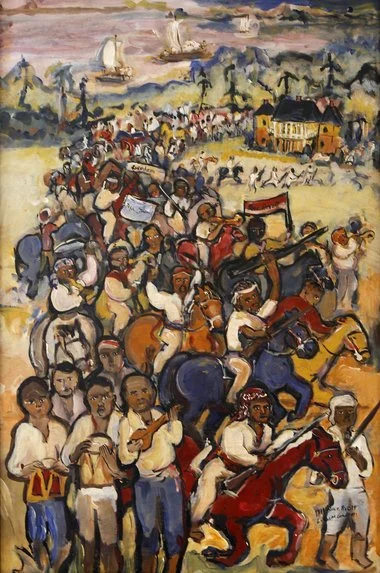
YEAR: 1811German Coast Rebellion
The Haitian Revolution, victorious in 1804, sent shockwaves across the Americas. The revolution took the ideals of the Atlantic revolutions to their true conclusions — liberation and equality for all. The U.S. ruling class was petrified by the victory of the Haitian Revolution, which established the first free and independent Black Republic by former slaves, and quickly and brutally sought to crush any potential revolution among the enslaved in North America. The German Coast rebellion was organized by Charles Deslondes, born in Haiti, who came to the U.S. to organize maroon communities along the Gulf Coast.
Terrified by that example, enslavers and militia hunted down the rebels within days, executing dozens and displaying their severed heads along the river road as a warning. Yet the uprising's scale and organization reveal a history deliberately suppressed: that enslaved people were not passive victims but revolutionary agents, part of a hemispheric wave of Black liberation struggle that stretched from Haiti to Louisiana to Virginia, undeterred by the certainty of brutal reprisal. While ultimately violently repressed by white authorities in New Orleans, the rebellion stands as a watershed moment in the long struggle for abolition and reconstruction.