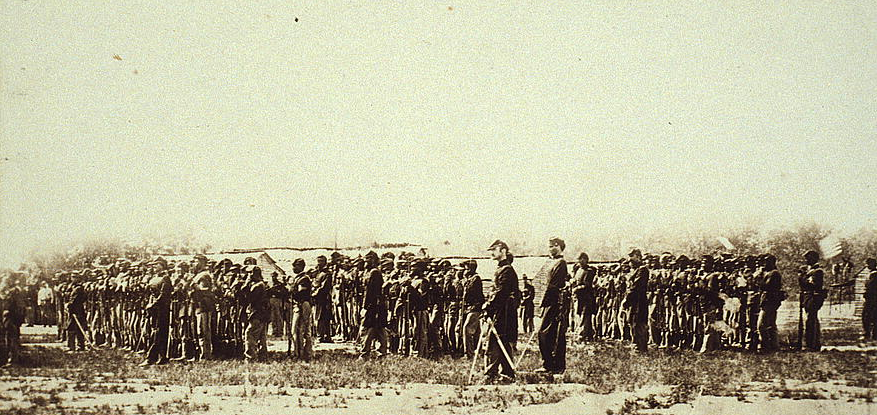
YEAR: 1861-1865The Civil War
We often hear how the Civil War was “a war to preserve the union” – but for the Northern government, “preserving the union” meant preserving the capitalists ability to maximize their profits. While the Civil War did ultimately result in the abolition of slavery in the United States, at the beginning of the war, Abraham Lincoln, the “moderates”, and their military officials were clear that they had no intentions of ending chattel slavery. One Union general promised to put down any slave insurrection “with an iron hand”, while others went out of their way to send back fugitive slaves who escaped and sought refuge behind Union lines. To embrace and recruit Black Americans was the Union’s surest path to win the war, but doing so also jeopardized the economic position of, for example, Northern factory owners, who relied on Southern cotton to run their factories. And for obvious reasons, the Confederacy – whose entire economy was driven by four million enslaved Black people – were invested in continuing the institution of slavery.
In the context of the war, both the North and South viewed Black Americans as objects to be acted upon and directed by the white elite – but in reality, that was never really the case. Over time, as the Union began to understand the strategic position of the enslaved in the war, it gradually shifted its orientation to the question of slavery. Under the pressure of widescale protests against the war draft – and the potential for Western European powers to formally recognize the Confederacy – Abraham Lincoln signed the Emancipation Proclamation. But it wasn’t until 4.5 million enslaved Black people were galvanized to fight a moral crusade against slavery that abolition was really won. Black freedom was won through persistent struggle against slave masters to the very end – not simply because of any paper declaration.