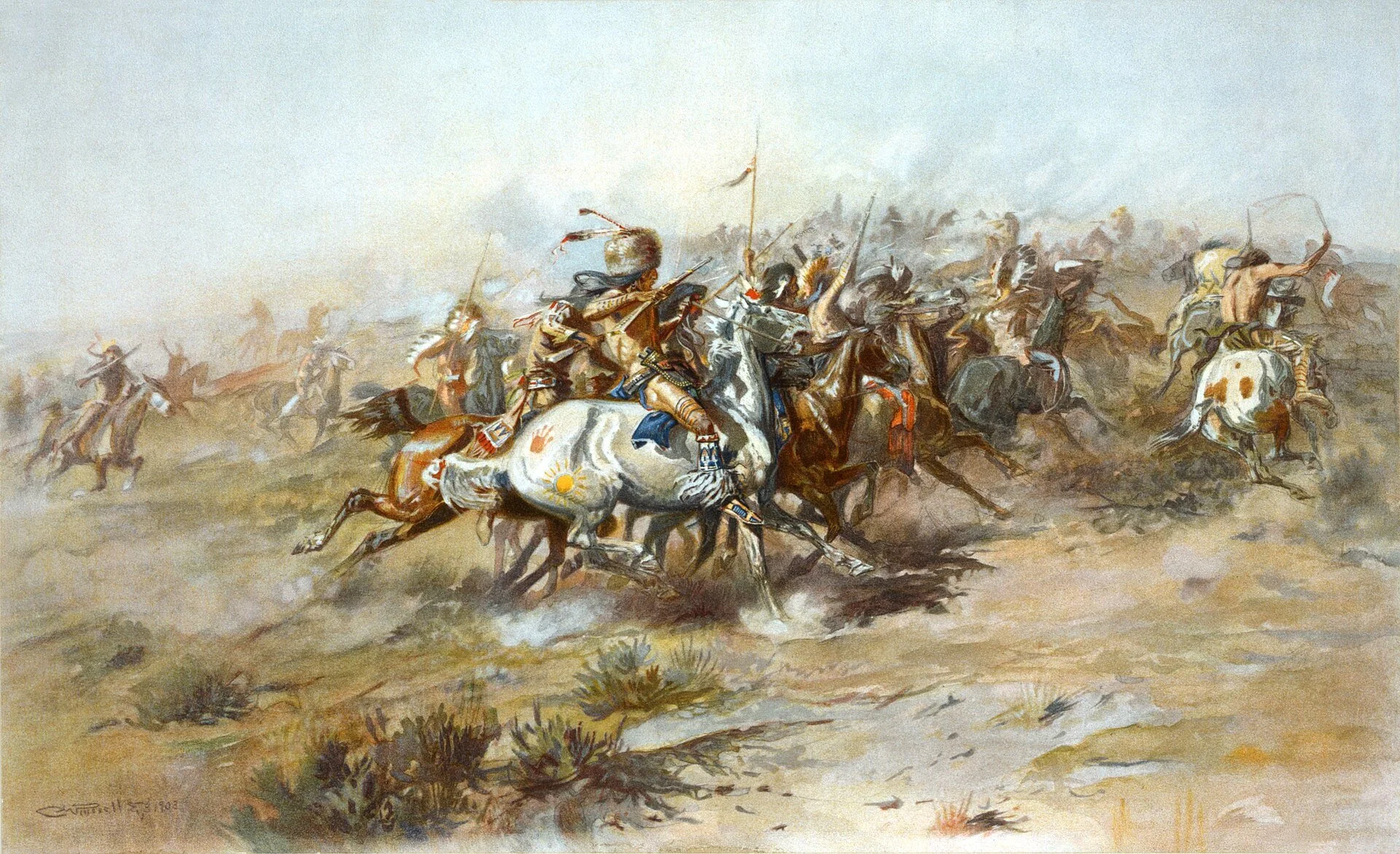
YEAR: 1876Battle of the Greasy Grass
The Battle of the Little Bighorn, known to the Lakota as the Battle of the Greasy Grass and to white textbooks as “Custer’s Last Stand,” was a pivotal battle in which a coalition of Lakota, Northern CHeyenne, and Arapaho warriors under the leadership of figures like Crazy Horse and Sitting Bull defeated the U.S. 7th Cavalry.
White supremacist histories describe the battle as an unprovoked “massacre” of Custer’s army when in fact it was a successful defense by a coalition of native nations that delayed the further colonization of the Black Hills (in which gold had recently been discovered) for several more years. The expansion of the U.S. into the Black Hills was a violation of the Treaties of Fort Laramie treaties which established the sovereignty of the Northern Plains nations over the territory in U.S. law.
The victory at Greasy Grass, and the legacy of the broken Treaties at Fort Laramie, remain powerful touchstones of indigenous political, military, and material sovereignty.