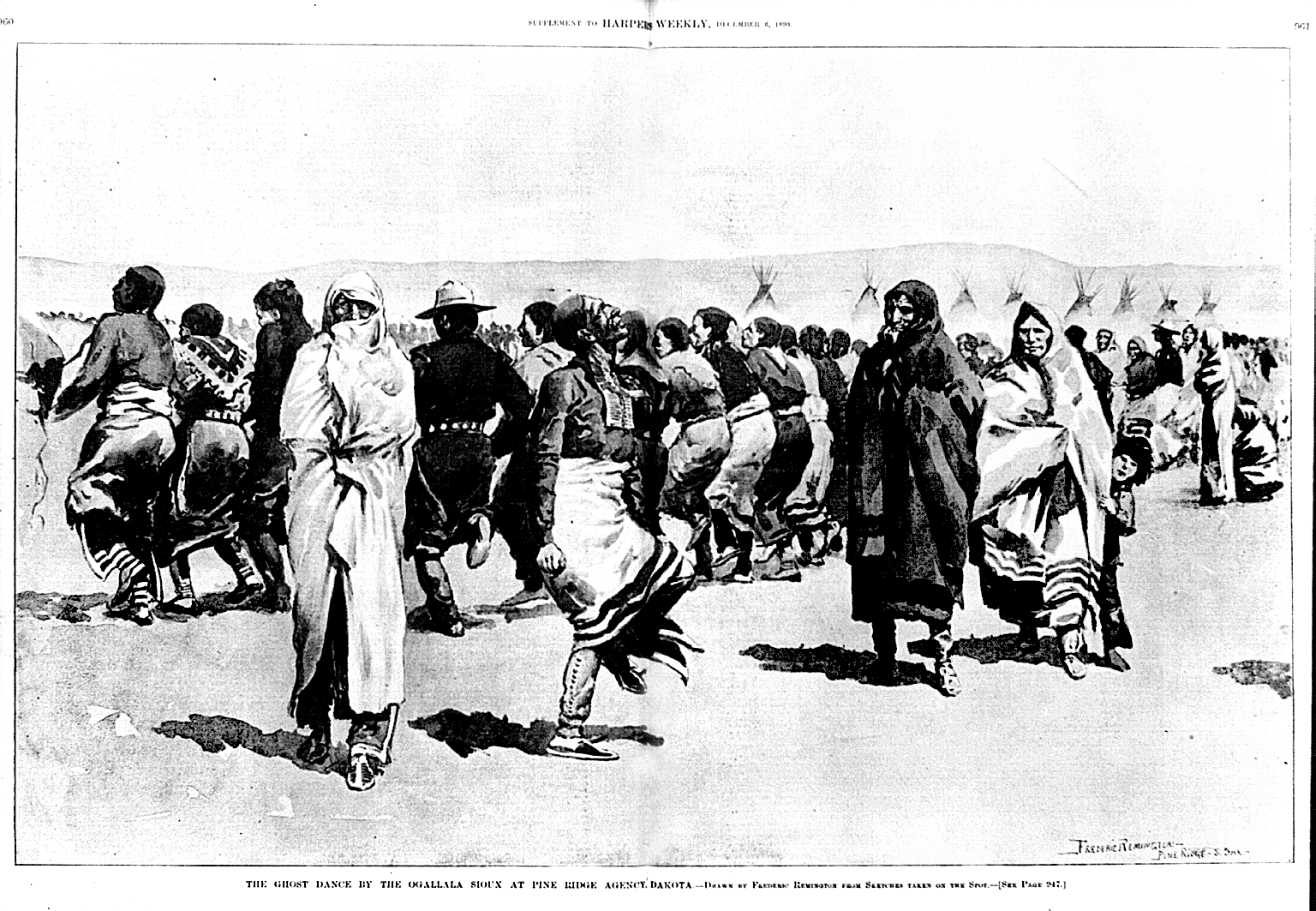
YEAR: 1890Ghost Dance and Wounded Knee Massacre
By the late 1880s the Lakota people had been largely confined to reservations after decades of fierce resistance against war and broken treaties. The Ghost Dance was a movement of spiritual revival and a call for earthly renewal, imagining a world in which the land was liberated and the Buffalo revived. The Ghost Dance became a mass movement among the Plains nations. This spiritual movement was seen by the U.S. government as an existential threat, and brutally repressed by federal authorities.
The U.S. government believed that Lakota leader Sitting Bull was the motor force behind the Ghost Dance and had him assassinated in 1890, after which a band of Lakota took refuge at Wounded Knee Creek. U.S. troops arrived, disarmed the camp, and massacred nearly 300 Lakota men, women, and children. This crime marked the end of the so-called “Indian Wars,” and a new phase of U.S. capitalism and indigenous resistance.