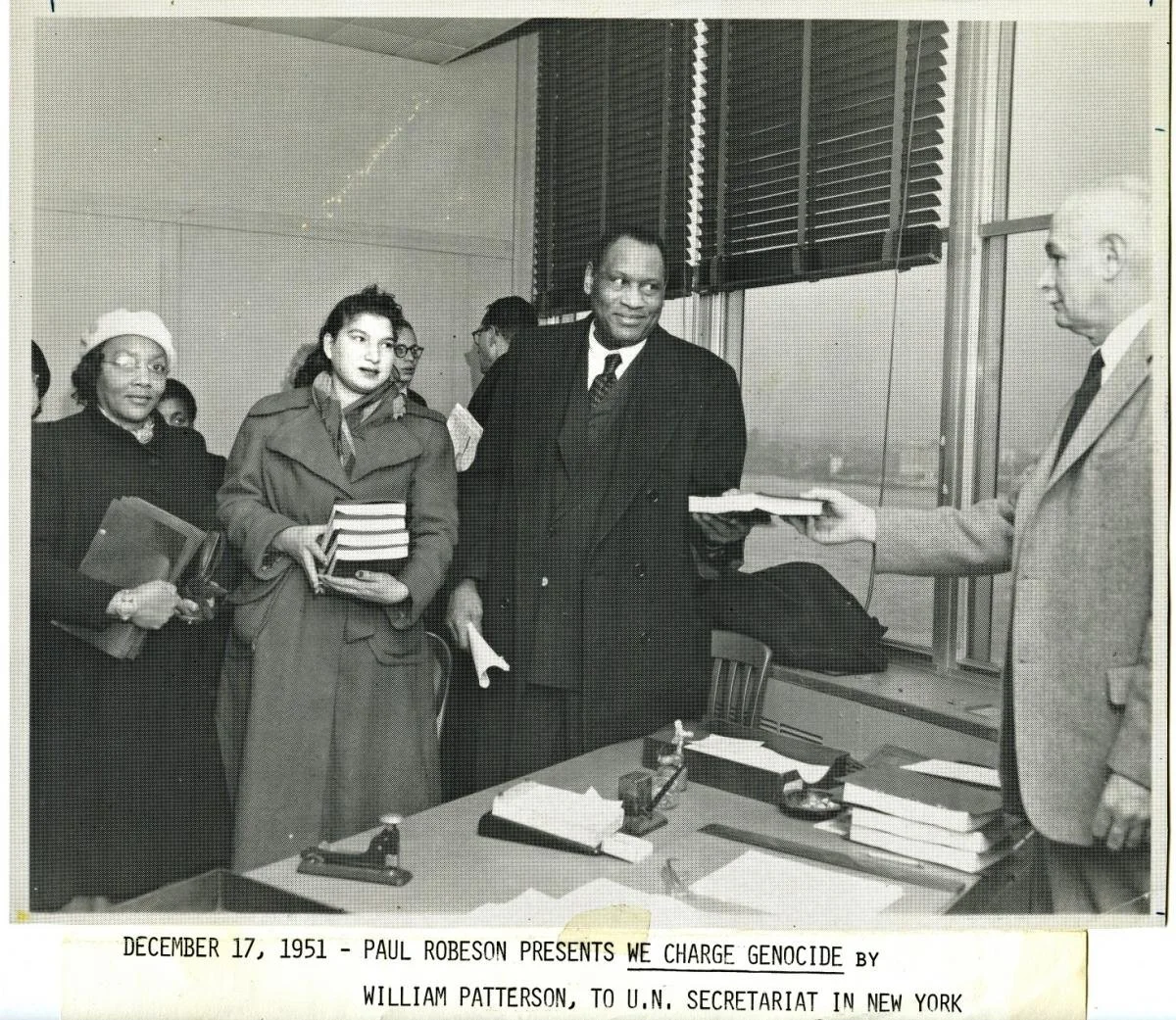
YEAR: 1951“We Charge Genocide” petition presented at the United Nations
On December 17, 1951, Paul Robeson and William Patterson submitted a petition from the Civil Rights Congress (CRC) to the United Nations. The 200-page petition, titled, “We Charge Genocide: The Crime of Government Against the Negro People,” was signed by almost 100 U.S. intellectuals and activists. Artist and activist Paul Robeson led a delegation to present the document at U.N. Headquarters in New York, while CRC Secretary and lawyer William Patterson delivered it to a U.N. meeting in Paris. W. E. B. Du Bois was scheduled to accompany Patterson to Paris, but the U.S. State Department prevented him from leaving the country.
Drawing on evidence compiled from the Black press, the NAACP, the Urban League, and various government hearings, the petition documented a pattern of lynchings, police killings, legal discrimination, and disenfranchisement of Black Americans, arguing that these constituted genocide under the definition established by the UN's 1948 Genocide Convention. The document also connected systemic denial of healthcare, housing, and employment to a shortened life expectancy among Black Americans, presenting these conditions as part of the same genocidal pattern rather than separate issues.
The U.S. government maneuvered to prevent the UN from formally debating or even considering the charges brought in the petition. Working behind the scenes, they were able to prevent any discussion of the petition by the U.N. Commission on Human Rights. The CRC was labeled a Communist front group, and its leaders, William Patterson, Paul Robeson, among others, were barred from traveling and faced heavy persecution.